Not everything happens online: the physical store, digital marketing’s biggest dead-end data
Nearly 90% of sales take place in-store. Romain Baert, Managing Director Server-Side Tagging, explains how to leverage your offline and server-side data to drive your retail ROI.


There’s one statistic that digital marketing would rather forget: e-commerce accounts for about 12% of retail sales in France. Looking at it the other way around, this means than nearly 90% of product sales still take place in person, face-to-face with a person at a checkout counter.
In other words, while we’re fine-tuning our attribution models, our audiences, and our automated bids, the overwhelming majority of the business generated by these campaigns takes place in a place where no pixel is triggered.
Not everything happens online. And that’s precisely where the biggest dead-end data in modern marketing lies.
The Saturday afternoon that defies your dashboards
Spend a Saturday in any appliance, sporting goods, or home improvement store, and take a look around. One out of every two customers has a phone in hand, comparing prices, reading reviews, or checking a product listing they’ve already looked at three times this week. The others have come for what the internet can never give them, which is the ability to see the product, touch it, hold it in their hands, or simply ask someone who knows their stuff.
This behavior is called the ROPO effect, short for “Research Online, Purchase Offline.” And it’s by no means a marginal phenomenon. According to the Solocal/GroupM shopping journey observatory, 80% of consumers conduct online research before making a purchase in-store (a finding corroborated by a Criteo study that reports figures of a similar magnitude).
Salespeople, for their part, didn’t need studies to know this. Ask any sales associate, and you’ll learn that customers walking through the door today are prepared, well-informed, and often more knowledgeable about the product specifications than the staff members themselves. The store is no longer the place where people discover a product, but the place where they finalize a decision that was shaped by digital channels.
The retail industry has understood this well, and retailers are investing heavily in tablets for sales associates, ordering kiosks, click-and-collect initiatives, appointment scheduling, and more… Today’s point of sale fully embraces its role in a hybrid customer journey where the customer experience (just like the journey itself) is omnichannel.
While the experience is becoming omnichannel, there’s one place where it still doesn’t exist: your analytics.
Two budgets, two worlds, zero bridges
Because the reality for most retail executive committees is that the digital acquisition budget operates in one silo, and the merchandising and in-store advertising budget operates in another. Two teams, two P&Ls, two reporting frameworks. Digital is judged on its online conversions; the store is judged on its revenue per square meter. And between the two, nothing.
The paradox is striking. ROPO behavior is now a well-established fact, yet efforts to demonstrate it internally (backed by hard data) remain minimal. People readily admit in meetings that “digital drives traffic to stores,” but then go back to allocating budgets based on reports that completely ignore this phenomenon.
The result is that every sales receipt generated by a digital campaign is a dead-end data point. The sale is real in the sense that it’s been processed, paid for, and recorded, but it remains invisible to marketing, since no campaign receives credit for it, no algorithm takes it into account, and no budget allocation is based on it. The true ROI of your advertising investments is structurally underestimated, and no one knows by how much.
This isn’t so much a measurement problem as it is about decision-making. Without this data, it’s impossible to confidently manage budget shifts, impossible to justify a digital investment based on its total contribution, and impossible to make a truly data-driven decision about the online/offline allocation. We manage 90% of the business based on intuition and 10% based on data.
Server-side as a hub: push once, and it updates everything
What has changed in recent years is that the problem no longer lies with the platforms. CRMs have been structuring offline data for a long time; Google Ads allows you to import offline conversions to reconcile them with clicks; and Meta accepts offline events (including receipts) via the Conversion API. And attribution solutions like Wizaly, Thank-You Analytics, and Eulerian natively integrate these offline dimensions into their contribution analyses.
In other words, ad networks want your in-store data, the tools know how to process it, and studies have proven that it changes how your performance is interpreted. So why do so few retailers do this?
Because until now, each integration was a full-fledged IT project. One data feed for Meta, with its own format, hashing, and freshness rules. Another for Google. A third for the attribution tool. Each requires scoping, development, testing, and maintenance. Multiplied by the number of platforms, the cost becomes prohibitive, and the omnichannel project gets bogged down in investment committee meetings, lacking the data to prove its own profitability (ironically).
This is exactly where server-side technology changes the nature of the problem. A server-side infrastructure is a data hub that you control, situated between your systems and the platforms.
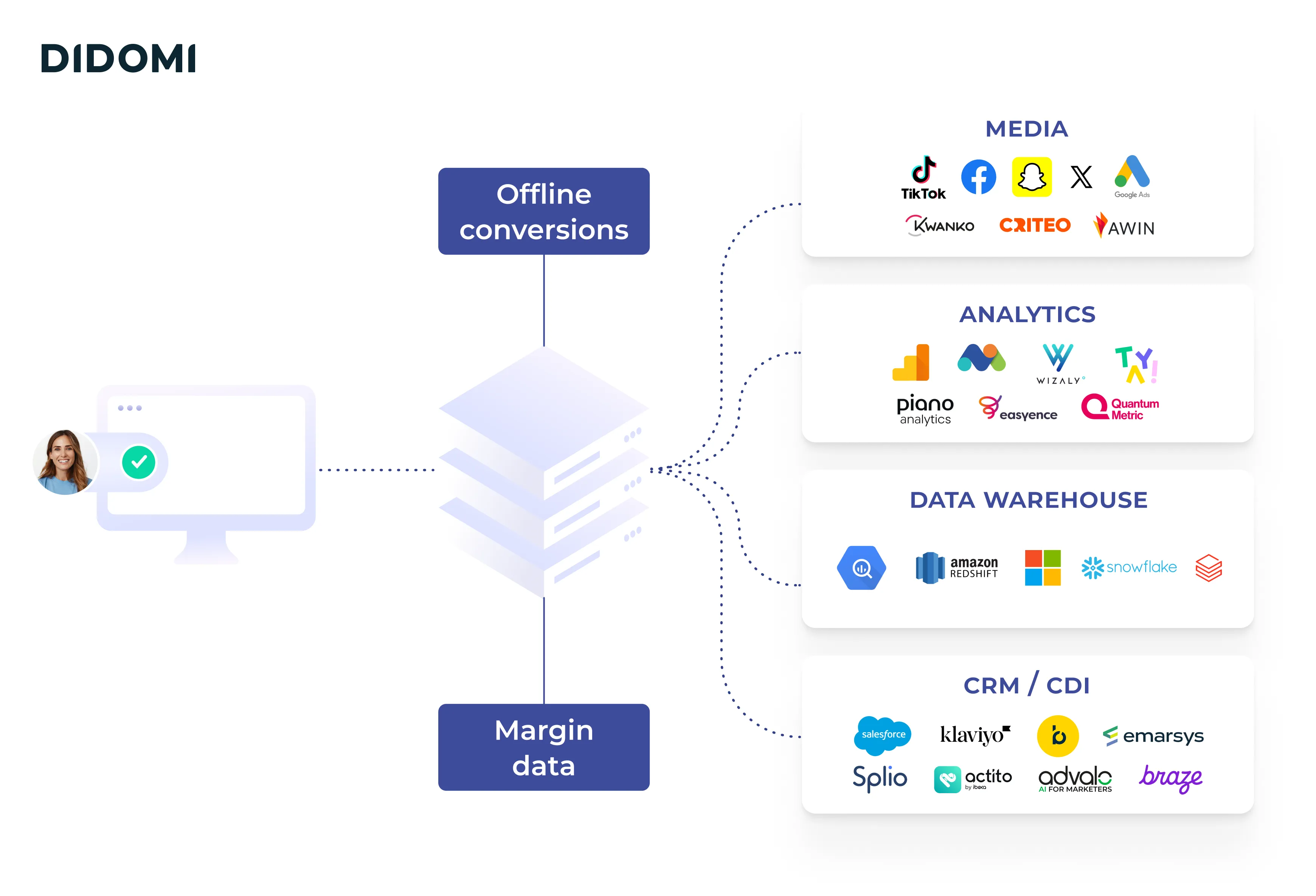
You do the work once. Your receipts are uploaded to your server in a single stream, in a single format, under a single governance framework, with consent and compliance included. From this hub, you feed all the ad networks and tools that accept this data. Adding a new destination tomorrow is no longer a project but simply a connector. The topic moves off the technical roadmap and onto the business roadmap, where it should have been all along.
The effect is also cumulative, since every uploaded receipt enhances campaign optimization, which drives higher-quality in-store traffic, which in turn generates sales that can finally be attributed, thereby justifying future decision-making. Dead-end data becomes an asset.
The question you want to ask at the next budget committee meeting
Your customer has long since resolved this issue by researching your website on Tuesday evening and making a purchase at your store on Saturday, without ever wondering which budget category that sale will end up in.
So, the real question to ask during the next budget review isn’t how much to allocate to digital versus in-store, but how much longer are you going to manage 90% of your business using reports that don’t account for it?
The author