Moving beyond ROAS to POAS for profit-based optimization
James Ensor, Global Lead Server-Side at Didomi, explains why ROAS can hide losses and how to send basket-level profit to ad platforms with POAS.

For years, Return on Ad Spend (ROAS) has been the north star metric for e-commerce advertisers. But there’s a growing problem. Campaigns can hit an impressive ROAS and still lose you money.
As bidding algorithms on Google and Meta become more powerful, the smartest advertisers are feeding them a better signal: profit.
The problem with margin-based segmentation
The traditional workaround for profitability has been to group products into margin-based campaigns. Put your 50% margin products in one campaign, your 20% margin products in another, and set different ROAS targets for each. On paper, it makes sense.
In practice, it falls apart for the simple reason that in many cases, people don’t buy what they clicked on.
Someone clicks an ad for a navy shirt with a 50% margin, browses the site, and checks out with a grey cardigan at 25% margin instead. Or they buy both, plus something else. The ad platform attributes that revenue back to the original click, but the basket’s actual profitability bears no relationship to the campaign’s margin assumptions.
When the link between the product clicked and the product bought is broken two-thirds of the time, margin-based segmentation simply doesn’t work.
The solution: send basket-level profit to the platforms
Instead of approximating profitability through campaign structure, calculate the real profit of every order and send that number back to Google and Meta as the conversion value. This shifts optimization from ROAS to POAS (profit on ad spend), a term coined by Profitmetrics.
The calculation works at the order level. Take the revenue (excluding VAT), then subtract discounts, product costs, shipping, packaging, and payment fees. What’s left is gross profit. Take, for example, a $100 order: after a $10 discount, $50 product cost, $2 shipping, $1 packaging, and a $1 payment fee, you’re left with $36 gross profit. If you spent $16 on ads to win that order, your net profit is $20, a POAS of 125%. You made $1.25 in profit for every $1 spent on ads.
Tools automate this by combining order data from your store with product-level Cost of Goods Sold (COGS) data, then sending net profit to Google, Meta and GA4 via API in real time. As a result, gross profit, net profit, and POAS appear as columns directly in your campaign reporting, and crucially, the bidding algorithms can optimize towards them.
Key steps to put profit data to work in Google Ads
The implementation comes down to a few key steps:
- Change your primary conversion action to the profit-based conversion, so Smart Bidding optimizes towards profit rather than revenue.
- Set your ROAS target to your POAS target. A 1.1x POAS pushes top-line growth, around 1.4x balances growth and profitability, and 2x maximizes the bottom line.
- Consolidate your campaigns. Those separate 10%, 20%, and 50% margin campaigns with wildly different ROAS targets can collapse into a single POAS campaign, giving the bid strategy the volume it needs to learn. Aim for at least 50 conversions per month per campaign for the bid strategy to perform.
Finally, test your way to maximum profitability. Net profit typically rises as you increase your POAS target, peaks, then declines as volume drops off. Finding that sweet spot is where the real gains live.
The results speak for themselves
Maisons du Monde, the European furniture and home decor retailer, ran into this exact problem:
Initially, we tended to adopt a pre-click logic, thinking that we should focus investments on high-margin products and reduce spending on lower-margin ones. However, a clicked product is not necessarily a purchased product, and the number of items in the cart can vary.
- Victoire Clouët des Pesruches, Head of Performance Acquisition at Maisons du Monde
To fix this, they turned to Addingwell. Server-side tracking changed how Maisons du Monde fed Google Ads, enriching each conversion with the actual contributive margin of the products purchased, and tracked post-click conversions so bidding reflected what customers really bought. Server-side collection also reduced data loss from ad blockers and browser restrictions like Safari ITP, so the margin signal reaching Google was more complete.
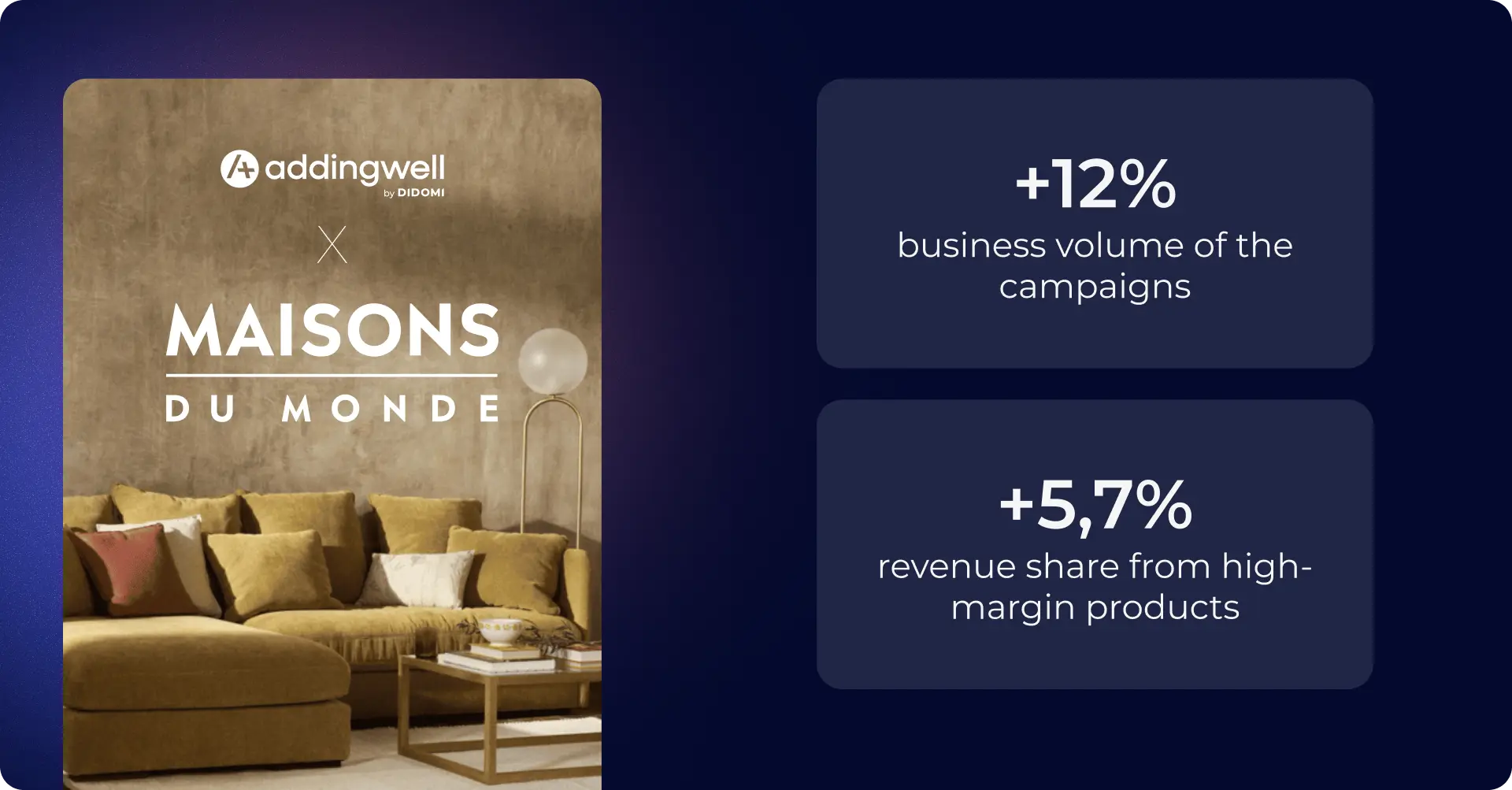
The results: +12% business volume across the campaigns, and a 5.7% increase in the revenue share coming from high-margin products. In other words, the brand grew volume while shifting its mix towards the products that make money.
Get started with POAS today
Revenue is vanity; profit is sanity. By moving beyond ROAS to POAS, you stop optimizing for a number that flatters your campaigns and start focusing on the number that actually grows your business.
To get there, you don’t need to rebuild your entire stack. Start with reliable post-click conversion data, enriched with actual margin and delivered to your ads platform without the losses caused by ad blockers and browser restrictions. This is what Addingwell’s server-side tracking is built for, and how our clients move from clicked-product logic to basket-level margin.
Talk to one of our experts today to discuss how your specific business could benefit from profit-based optimization.
The author