Before you tag: the business and technical decisions behind a Data Manager API build that actually moves your numbers
Doug Hall, Technical Director at Duga Digital, breaks down the four Data Manager API use cases his team ships most often, and why decisions made before the build matter more than the architecture.


It's Monday morning. Your team has the Data Manager API documentation. You have watched every Measure Summit talk twice. Your typical tag choice is loaded into your server-side GTM container, ready to go.
And yet which use case to ship first is unclear: what should be in the payload, who actually owns the sales file, how do you collect the necessary data, what’s the consent solution?
If that scene sounds familiar, you are exactly where we were some months ago.
The Data Manager API is real. The tag template is functional. Google's recent updates (store sales conversions, GA4 event ingestion across web and app, expanded additional data source support) have changed what is possible. The tech is ready. You have questions…
This is what we have learned.
Questions, and answers
You probably have a version of these on a whiteboard somewhere already. Every Data Manager API engagement starts with the same handful of questions: easy to ask, awkward to answer, and impossible to ship around. The four we hear most often:
- Where does the gclid live between the ad click and the offline conversion three days later?
- Whose hashed email do you trust when the form email and the checkout email differ?
- Do you have consent to do this?
- Which destination wins when marketing and finance disagree on what counts as a sale?
These are the questions a Data Manager API engagement actually turns on. They are decisions, not deployments. They are change management as much as they are tagging. They cut across marketing, paid media, CRM, finance and engineering, and they need someone who has been through them before to make the answers stick.
From decisions to build
Several engagements later, what we ship has a settled shape. The platform underneath is an Addingwell sGTM container. The dispatcher at the end of every pipeline is a Data Manager API tag we built ourselves: purpose-designed around the questions above and the use cases below, and the piece on which the whole thing hinges.
The decisions still belong to the client. The build that makes those decisions ship cleanly is ours.
We run the same four-row decision lens in every engagement:
- Business decisions: what counts as the event, what value goes on it, who consumes the result, what cadence the business actually needs.
- Data decisions: which identifiers are available, where they live, what is hashed, what is consented.
- Architectural decisions: real-time or batched, where the join happens, where state is stored, which platform hosts sGTM.
- Operational decisions: who owns the source file, who monitors, what the SLA is, how multi-brand is handled.
The next four sections walk through the use cases we deliver most often: offline sales, online sales, online lead generation to offline conversion, and audiences. The architecture stays much the same across all of them. The decisions are what change the answer.
Use case 1: Offline sales (showroom or store to Google Ads)
The scenario: sales happen offline, in a showroom or store, and need to land back in Google Ads as conversions tied to the original ad click. Two flavours: batched (a file on a schedule from EPOS or CRM) or real-time (an event the moment the sale closes). Most of the decisions are identical. The few that differ are the ones to focus the conversation on.
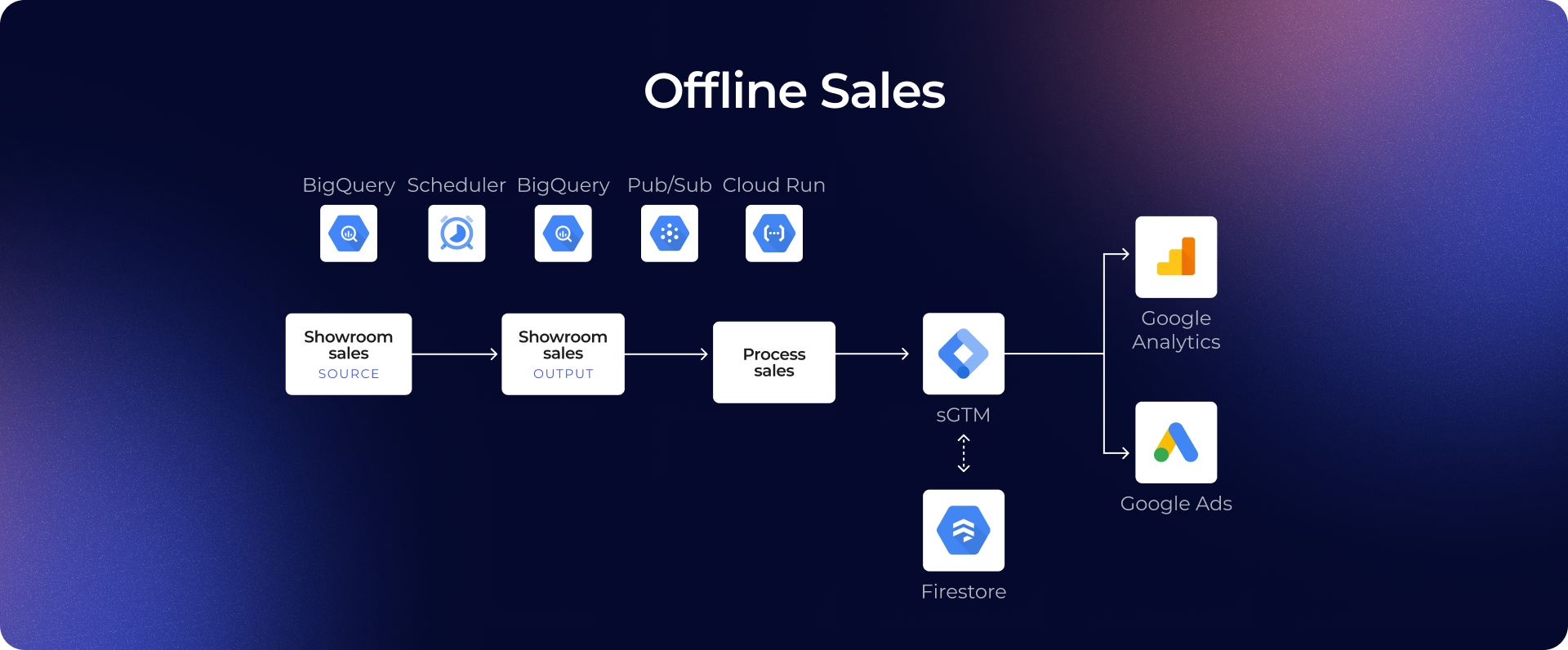
Business decisions
- What counts as a sale for Ads: booking, deposit, full purchase, delivery?
- What value goes on the conversion: transaction total, gross margin, a lifetime-value proxy?
- Are you multi-brand or multi-account, and which brands ship in v1?
- What cadence does the business actually need, and is there a consumer beyond Google Ads that genuinely cannot wait?
Data decisions
- Is there a transaction ID present in both the online journey and the offline sale?
- What user-provided data is available for hashing: email, phone, name, postcode?
- What is the consent posture for each of those identifiers, and how is it recorded?
- Does the sales record already carry the gclid, or does it need to be joined back from earlier in the journey?
Architectural decisions
- Real-time or batched, and on what evidence?
- Can the source system emit events reliably, or can it only produce a scheduled file?
- Where does the gclid-to-sale join happen, and where is the state held while it waits?
- Which platform hosts sGTM?
Operational decisions
- Who owns the source file or the event stream?
- Who monitors the request and response log, and how often?
- What validation evidence is required at go-live, and what is checked weekly thereafter?
- What is the SLA for a missed conversion, and who is on the hook outside business hours?
Choosing real-time or batched
Most teams ask this backwards: they want real-time, then look for a justification. Start with the consumer, and let that pick the cadence.
The healthy default is batched. Not because Google Ads wants stale data (it does not, and fresher signal is genuinely better for bidding), but because most businesses cannot justify the engineering and operational cost of real-time against the marginal lift it delivers. Real-time earns its place when a second consumer (customer comms, audience refresh, an internal dashboard) genuinely cannot wait, or when volume is high enough that fresher signal materially improves bidding.
Three factors usually settle the rest:
- Source capability: build for what the source system can reliably do today. If it is file-only, the decision is made for you.
- Failure mode: batched fails loudly and backfills easily. Real-time fails quietly, and only becomes reliable once you have built the queue, the replay and the on-call rota to support it.
- Volume and cost: cost scales with cadence. Low-volume, high-value businesses almost always sit better on batched. High-volume, dense-frequency businesses sometimes earn the cost back through bidding feedback.
Pick one path and build it well. Running both adds reconciliation overhead that rarely pays for itself.
Use case 2: Online sales (Shopify and other ecommerce platforms)
The scenario: a Shopify (or equivalent) checkout completes online, and the order needs to reach Google Ads and GA4 through the Data Manager API with full user-provided data and click identifiers attached.
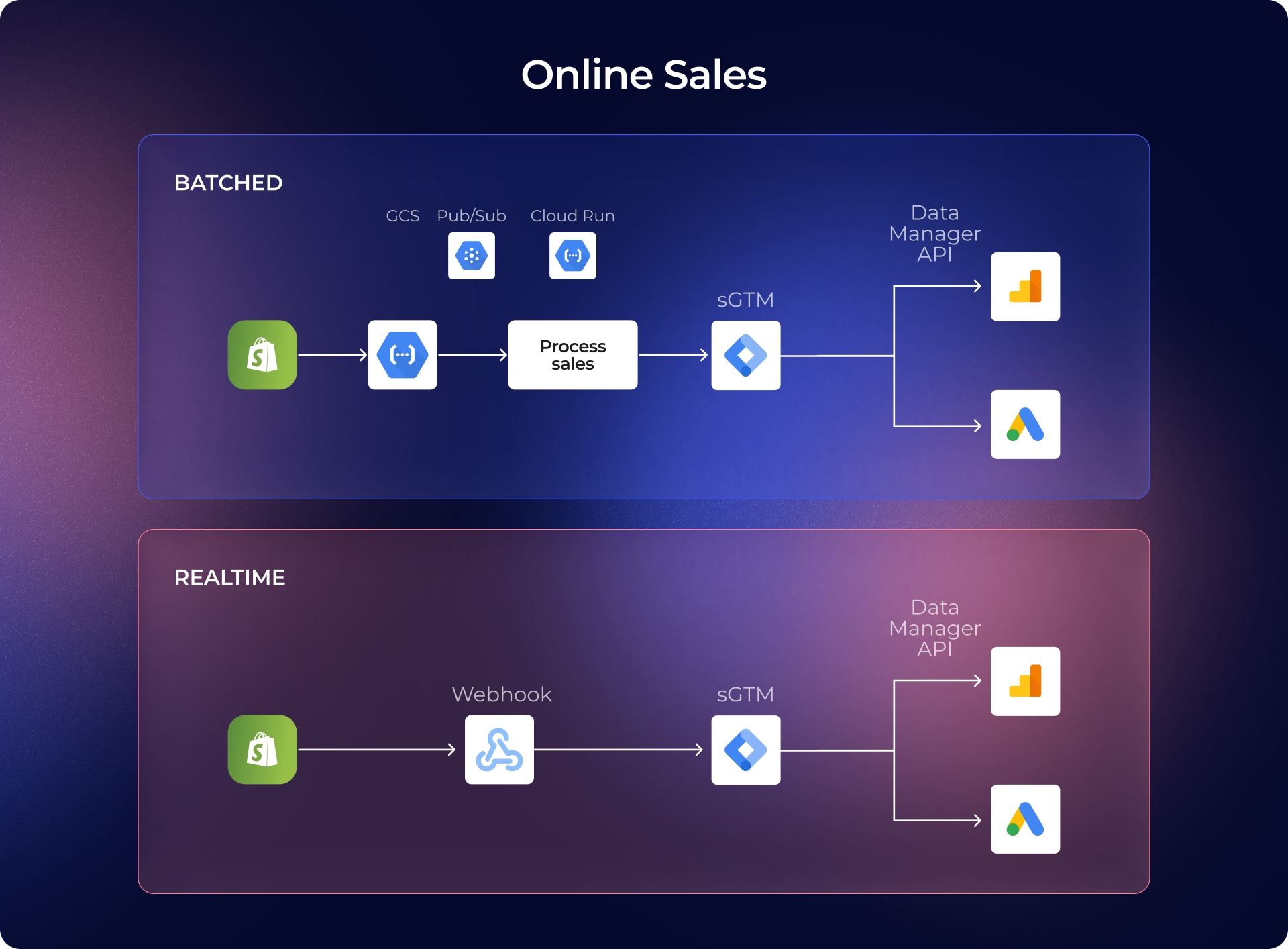
Business decisions
- What does the richer signal mean for bidding, and how is the resulting shift in reporting managed with the client?
- What does the product team treat as the canonical transaction: order created, paid, or fulfilled?
- Are returns, partial refunds and cancellations in scope, and how should they be reflected in the conversion?
- Which revenue figure goes on the conversion, and does that match what finance considers the truth?
Data decisions
- How are gclid, client_id, session_id, FPID and landing page collected, and where do they live between landing and checkout?
- What user-provided data is available at checkout for hashing: email, phone, name, address?
- What is the consent posture for each field, and is the consent state recorded with the order or only client-side?
- Are you sending multiple identifier sources per transaction to improve match rate, and what is the structure?
Architectural decisions
- Real-time at checkout, or batched from an export?
- Where is the transaction reshaped into the Data Manager API schema, and who owns that code?
- How does the gclid travel from the landing page through to the order record reliably?
- Which platform hosts sGTM?
Operational decisions
- Who detects schema drift in the upstream export before it breaks the upload?
- Who owns the discrepancy report when expected and actual conversion counts disagree?
- What validation evidence is required at go-live, and what is checked weekly thereafter?
- How are refunds and cancellations reconciled with Ads?
Choosing real-time or batched
Online sales tilt towards real-time. The data is already there at checkout: the consent state is fresh, the user-provided data is complete, and the order can be sent to Google before the customer reaches the thank-you page. For most ecommerce businesses, that is the natural default.
Batched becomes worth considering when the storefront is locked down by the platform team and a server-side fire would require changes nobody wants to make, when the transaction has to be reconciled with finance before it is considered final, or when refunds and partial returns are a material part of the conversion profile. The volume, cost and failure-mode trade-offs from the offline sales section apply here too.
Use case 3: Online lead gen to offline conversion
The scenario: a lead is collected online (a form, a quote request, a call), becomes a customer days or weeks later through a sales team or showroom, and the offline sale needs to reach Google Ads tied to the original ad click. The interesting work here is the join across the time gap.
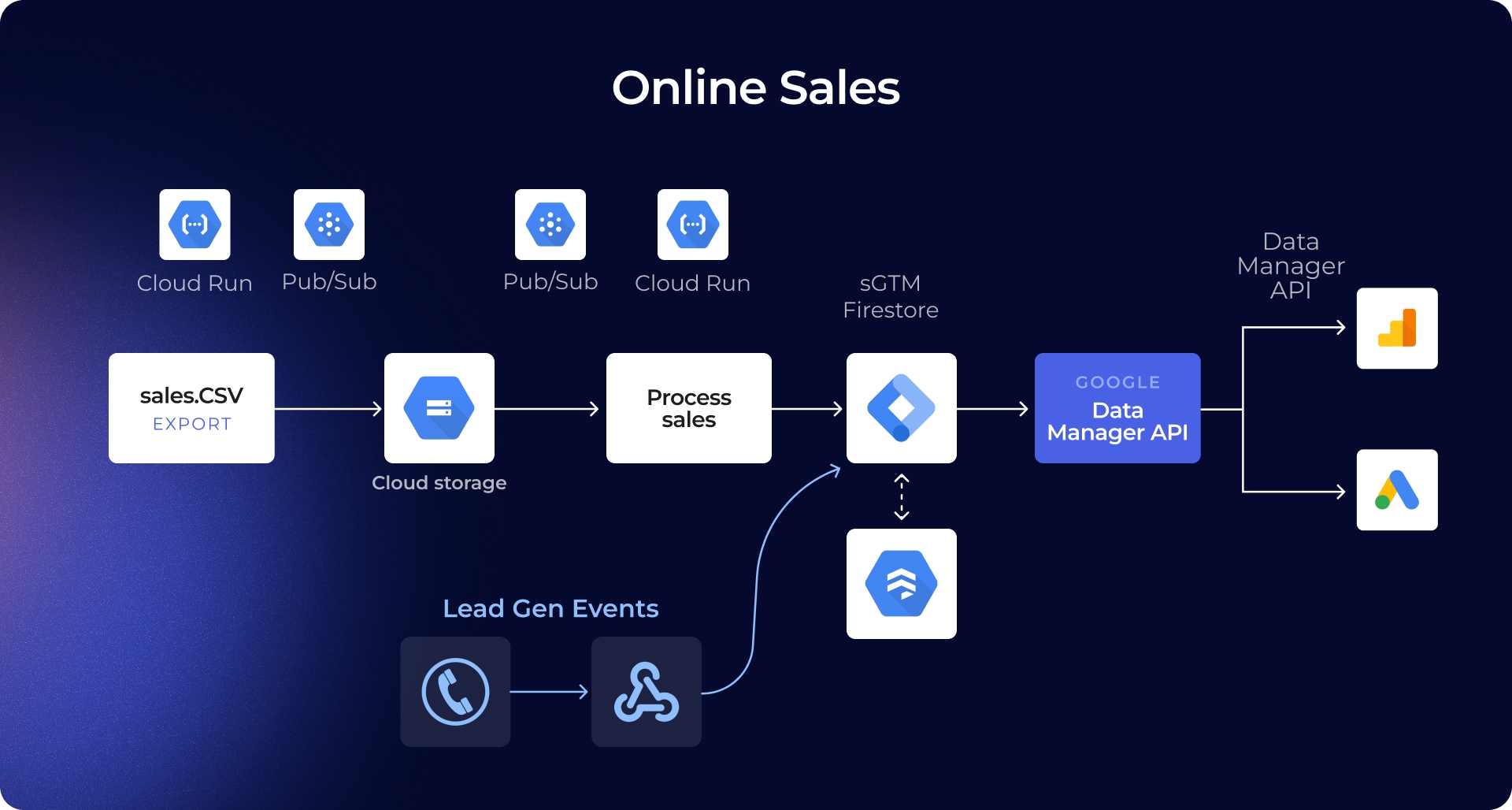
Business decisions
- What counts as a lead: form submission, qualified lead, SQL, deposit?
- What counts as the offline conversion: signed contract, paid invoice, delivered service?
- What is the typical lag between lead and conversion, and does it sit comfortably inside Google Ads' attribution window for the campaigns you care about?
- What value goes on the conversion: uniform, lead score multiplied by close rate, or actual sale value? This is a finance conversation, not just a media one.
Data decisions
- Which identifiers are collected at the lead moment, and which carry the most weight for matching back at conversion time?
- Where do those identifiers live during the gap between lead and conversion?
- How does the CRM rejoin the closed sale to the original lead?
- What is hashed, when, and by whom?
Architectural decisions
- How long must identifiers be persisted to cover the realistic conversion window?
- Real-time or batched for the conversion side?
- Where does the lead-to-conversion join happen, and which system owns the logic?
- Which platform hosts sGTM?
Operational decisions
- What is the retention policy for stored identifiers, and what happens to leads that take longer than that window to close?
- When a sale comes back without a matching lead record, what gets logged and what gets retried?
- Who owns the CRM-side integration, and who is alerted when it stops producing the expected throughput?
- What validation evidence is required at go-live, and what is checked weekly thereafter?
Choosing real-time or batched
The conversion side mirrors offline sales. Batched is the default for most clients; real-time earns its place when a downstream consumer beyond Ads genuinely cannot wait, or when sale frequency is high enough that fresher signal materially improves bidding. The volume, cost and failure-mode tests from Use Case 1 apply unchanged.
The lead-side capture is always a real-time job. There is no batched alternative for storing the click identifiers and consent state at the moment the lead arrives. That work has to happen the instant the form fires.
Use case 4: Audiences (Customer Match and equivalents)
The scenario: customer data sitting in your CRM that should be working harder. Current customers, lapsed buyers, high-value segments and suppression lists all need to reach Google Ads as audiences through Data Manager, where they directly drive bidding, suppression and lookalike seeding.
This data activation channel is often overlooked in terms of the value to be found in the data.
Google has invested most heavily in native integrations. The route from CRM to audience can be dramatically shorter than the route from sale to conversion.

Business decisions
- Which audiences actually drive media decisions today, not on the wishlist?
- What refresh cadence does the media team actually act on?
- What is the suppression policy: active customers excluded from acquisition, lapsed customers retargeted, high-value seeded into lookalikes?
- Who owns the audience definitions, and how are changes signed off?
Data decisions
- What identifiers are available per audience member: email, phone, postal address, mobile device IDs?
- What is the consent posture per audience, and how are regional variations handled?
- What is the hashing and normalisation approach for each identifier?
- How is membership change (someone joining or leaving the audience) detected at source?
Architectural decisions
- Is your CRM, warehouse or CDP one of Data Manager's native partners? If yes, that is your shortest route.
- Is the audience derived in the warehouse, in the CRM, or in a downstream tool?
- One audience fanned out to multiple destinations through Data Manager, or separate pipelines per destination?
- Which platform hosts sGTM for the audiences that need a bespoke build?
Operational decisions
- Who watches audience size for sudden drops, and what is the alert threshold?
- Who reconciles the CRM's view of the audience with Google's view, and how often?
- What validation evidence is required at go-live, and what is checked weekly thereafter?
- Who is on the hook when an audience refresh fails outside business hours?
Why audiences are often the quickest win
Most Data Manager API projects start with conversion uploads as the headline use case and treat audience sync as a phase-two consideration. That is backwards in many cases. Audiences drive media performance directly: better suppression cuts wasted spend, better retargeting lifts ROAS, and better lookalike seeds widen the top of the funnel without sacrificing quality. The data is already in the CRM. The activation is the missing link.
Data Manager has also made this dramatically easier than it used to be. Google maintains a list of native partner integrations covering major CRMs, data warehouses and customer data platforms. Use the integration where it exists. Build bespoke only where it cannot model the audience the business actually needs.
The pattern, and the harder problems
Four use cases. Different scenarios, different sources, different cadences. The decision lens is the same in every one.
That is the point. The Data Manager API rewards teams who treat decisions as the first-class deliverable and architecture as the consequence. Most of what we build at Duga is the same shape from one engagement to the next. Most of what we discuss is not. The conversations are what move the numbers.
We’ve written this post around the four use cases we see most often. They’re not going to be the only ones, and the Data Manager API itself is going to keep evolving.
A diagnostics or inspection layer in a future release? That would change the conversation entirely.
Will the DM API demonstrate a viable alternative to completely replace client side tags - a true server-to-server GA pipeline: What Measurement Protocol coulda/woulda/shoulda been?
Either way, the decision problems are getting more interesting, not less. Unusual identifier graphs. Tricky cross-border consent. Multi-brand audience strategies. Attribution gaps nobody else has solved. Those are the conversations we want to be having.
Duga runs the decisions and the build. Addingwell handles the platform underneath. If a problem on your desk sounds like one of the harder ones above, book a consultation with Duga. If you would rather start with the hosting layer, try Addingwell for sGTM. And if you have not read it yet, the companion post on Data Strength as the 2026 KPI sits behind everything written here.
The tag is the easy part. The decisions in front of it are where the work is. We are ready when you are.
The author
.jpeg)