Partner spotlight: Greg Stark, Marketing Consultant
James Ensor sits down with Greg Stark to discuss turning consent into value exchange, server-side tracking myths, and agentic commerce.

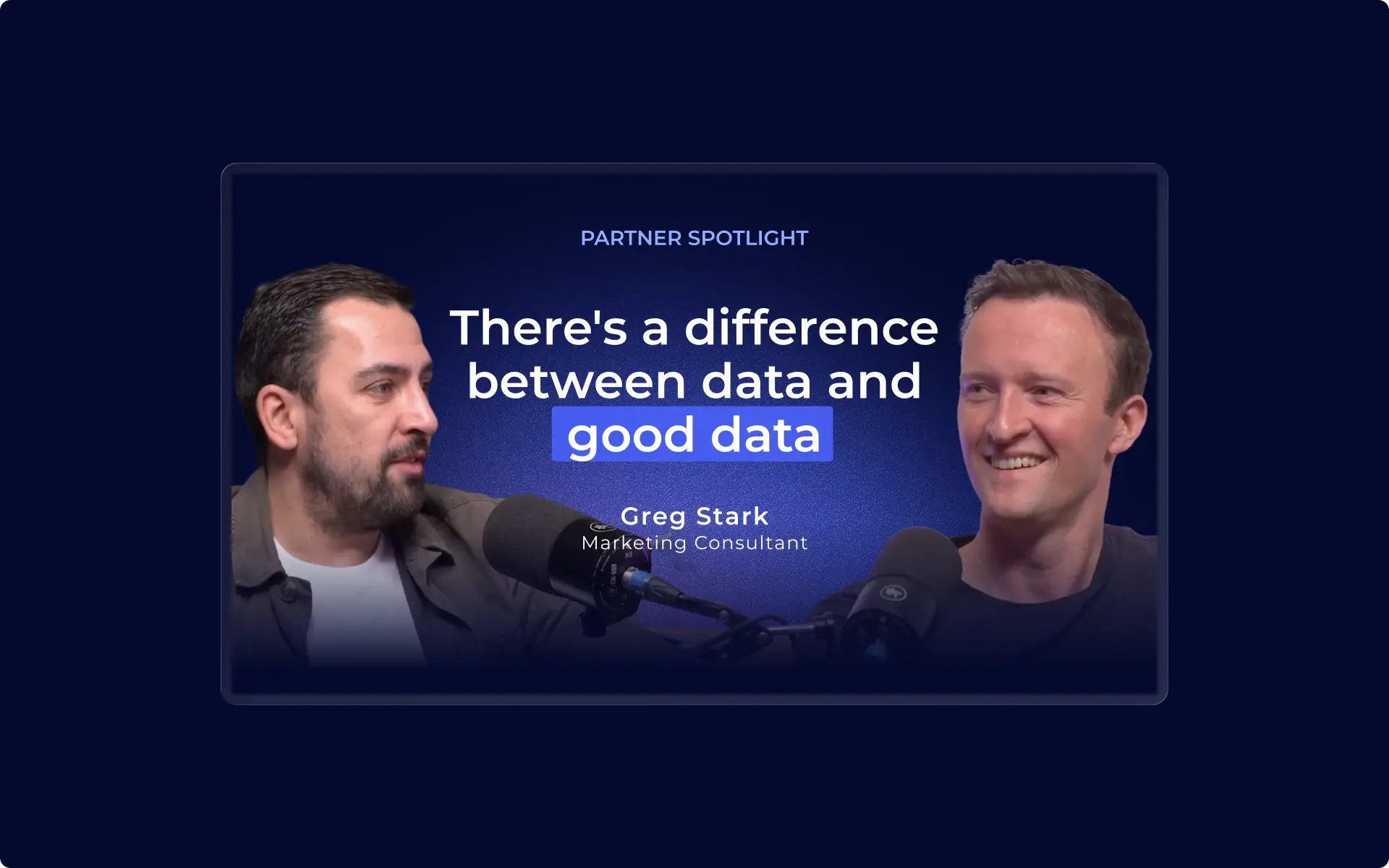
For the first installment of our partner spotlight series, we sat down with Greg Stark, a marketing consultant with experience working with clients across the retail sector like Ticketmaster, The Body Shop and BrandAlley.
In a 50-minute discussions, him and James Ensor, our Head of Sales UK, cover everything from Greg's background in marketing to the importance of turning consent into value exchange, server-side tracking myths, and the future of agentic commerce.
Watch the full video below, or continue reading to access some of the standout topics from the chat.
What has changed in Marketing over the last decade
Opening up the conversation, James and Greg discussed the current state of marketing, and how things have shifted for marketers over the past 20 years. For Greg, one of the most striking changes is how much more measurable and controllable things used to be surrounding data.
If we look back over the last decade, things were a lot more scientific (...) You could track almost everything, you could optimize in real time, and it rewarded an analytical and reactive mindset. You could see changes, you made changes, and you could see results. Most of that is gone now.
- Greg Stark, Marketing Consultant
That clarity has partly disappeared, due to a number of factors, including what Greg identifies as the prevalence of very large platforms marketers depend on for their operations:
Google, Meta... ultimately you're giving them a budget and they're going, 'We've got this now. Give us some signals, but we'll take care of this.' So a lot of the control you used to have isn't there anymore.
- Greg Stark, Marketing Consultant
Greg argues that the sprawl of channels and dashboards resulting from this isn't necessarily making teams more effective, and that the tension between more data and less control starts with consent, something he believes a lot of brands get fundamentally wrong.
User consent should be considered as a value exchange
Discussing the critical role of user consent in modern marketing operations, James and Greg then discuss the fact that it is still too often treated as a checkbox-ticking exercise rather than an opportunity for brands to build a relationship with consumers:
When it comes to consent, I think a lot of companies are still looking at it in the wrong way. They're looking at a consent banner as compliance, and "how do we do it as cheaply as possible and just not get a fine". Actually, what you need to be doing is some level of value exchange with the consumer.
- Greg Stark, Marketing Consultant
He emphasizes on the fact that the real fix doesn't lie in iterating on the text or button color of a banner, but in providing real value in exchange for their data, pointing at brands that managed to do so with initiatives like membership schemes:
I think it's more about being upfront with the consumer, going, "Look, give us your data and we'll give you something in return." (...) It's creating that relationship and that trust, and not just trying to be a bit shady about getting people to click on the banner.
- Greg Stark, Marketing Consultant
For Greg, they key lies in making the trade genuinely worth it for the consumer, before they even see the banner.
Server-side tagging alone is not a magic trick to get your data back
Once consent is working properly, the next step is the technical side, where Greg is often faced with misconceptions with his clients:
There's this misconception that server-side tracking means you're going to reclaim everything, almost like a backdoor. That you can circumvent Consent Mode. Obviously that's not the case. The initial biggest impact is picking up lost conversions through ad blockers and extensions etc. But this misconception that you're just going to get all your data back is incorrect. And that's why consent implementation is so pivotal to everything that comes after that.
- Greg Stark, Marketing Consultant
The two discuss the fact that server-side tracking is not a backdoor around user consent choices, but instead a way to recover data that gets lost to things like ad blockers and browser extension after the consent foundations have been established. And like consent, Greg emphasizes that it has to be an ongoing project for organizations that want to do it right:
Server-side tracking and consent aren't one-time projects, they're ongoing infrastructure. (...) It's not a put-it-in-and-leave-it thing.
- Greg Stark, Marketing Consultant
This relationship between consent and server-side tracking go hand-in-hand, as consent gets the right signal, which server-side tracking ensures reaches the platforms using the actual budget. That vision is what Didomi has been working on over the past year.
Preparing for an agentic future
The final part of the conversation looks into a future which Greg believes is already taking shape, where AI agents are the ones browsing the internet, comparing products, and buying on consumers' behalf:
Google doesn't want you to leave the platform. It doesn't want you to click on websites anymore, that's not the future for Google. The future is commerce within their platform.
- Greg Stark, Marketing Consultant
This perspective obviously presents massive consequences for the way companies market and sell their products, and turns first-party data into a critical currency for brands:
A shopping agent doesn't care about the color palette of your homepage. (...) All it cares about is the level of authority you hold in that space.
- Greg Stark, Marketing Consultant
Brands that already collect and leverage first-party data and build trust with their customers are best-positioned to face that vision of a not-so-distant future.
Closing words: Consent and server-side tracking require ongoing infrastructure
The lesson to take from this conversation between James and Greg is that consent, server-side tracking, and AI-readiness are all integral part of modern data operations that are massively important for marketing teams, and shouldn't be treated as one-time projects that you complete and forget about. They're effectively infrastructure that needs regular attention and ongoing maintenance to ensure you're making the right choices:
Bad data results in bad decisions. (...) There's a difference between data and good data. Getting swamped down in dashboards and metrics... what are you actually doing with the data?
- Greg Stark, Marketing Consultant
Whether it's auditing consent acceptance rates, making sure a server-side setup is actually recovering the data being missed, or getting first-party data in order before agentic commerce becomes mainstream, the brands that treat this as as a priority will be the ones ready for what's next.
Want to see how server-side tracking and consent management work together in practice? Learn how Didomi and Addingwell are opening up the server-side black box, and book a time with an expert to discover our platform.
The author