How to get the most out of your server-side tracking setup in 3 steps
Olivia Sabbagh, digital analyst and server-side tracking expert, introduces three levels of server-side maturity to help you maximize your tagging setup.

.webp)
In 2026, server-side tracking has become a prerequisite. But setting it up is no longer enough, and the marketing teams that stand out from the rest now aim to make the most of it.
Better collection, more reliable data, sharper signals for your advertising platforms... every step of the journey delivers concrete gains. But it is by going all the way that you gain a real competitive edge.
This article explains how to get there.
Step 0: Client-side tracking
Even today, most websites collect their data directly from the user's browser. A piece of code loaded on the client side sends events to their analytics tools (e.g. Google Analytics) and to their advertising platforms (e.g. Google Ads, Meta, Pinterest).
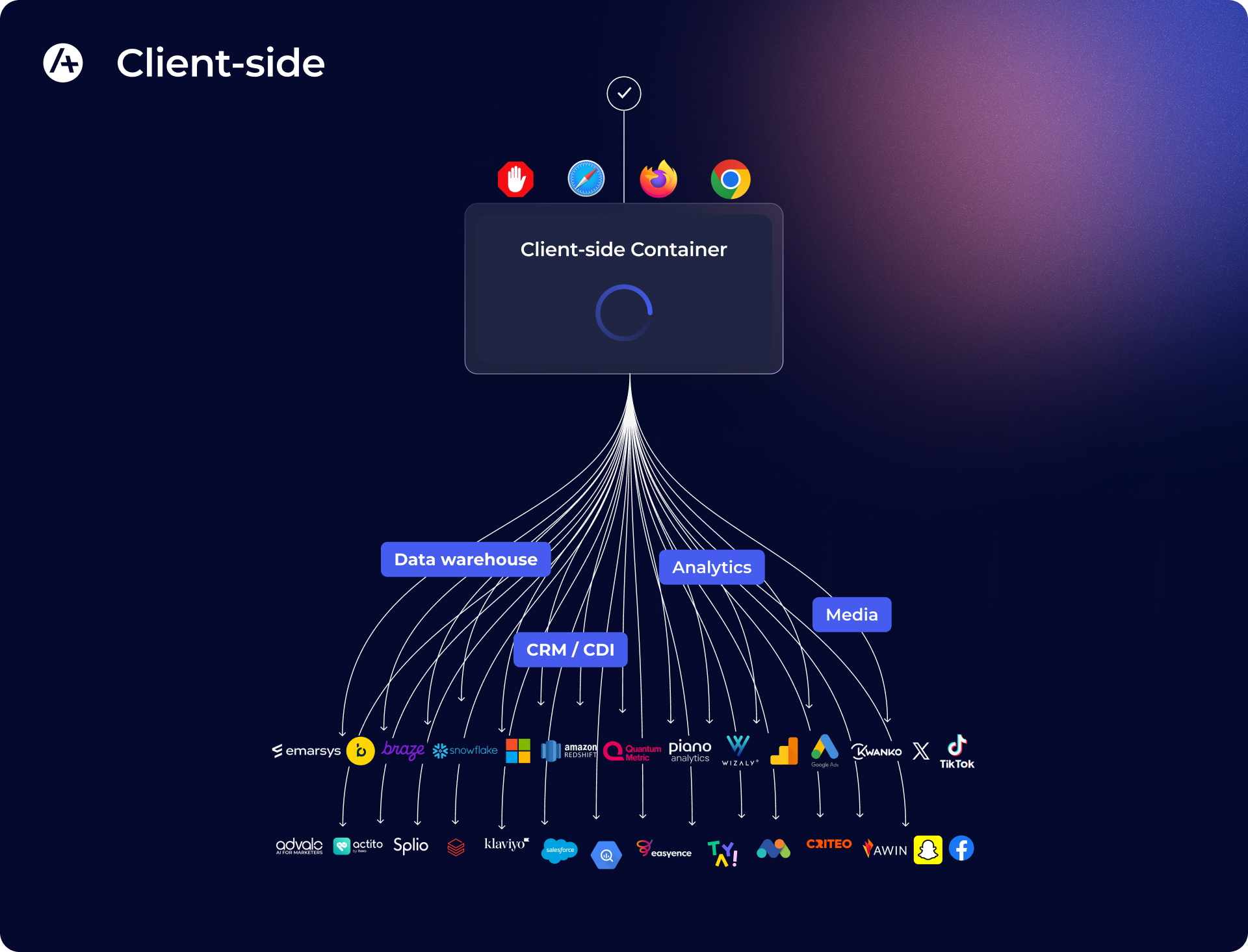
This model is now outdated. Adblockers intercept a growing share of signals, Safari limits the lifespan of cookies to 7 days, and some browsers such as Firefox and Brave now block third-party cookies by default. As a result, the data reaching your media partners is increasingly fragmented and unreliable.
Moving to server-side tracking is therefore essential.
Step 1: Migrate to server-side tracking
It all starts with the infrastructure. A GTM Server container is deployed on a subdomain attached to your domain (for example: metrics.yoursite.com).
This is where Addingwell comes in. Rather than managing the server infrastructure yourself, Addingwell gives you a turnkey solution that is reliable and quick to activate. This saves you time during deployment, guarantees that your servers run correctly, and lets your technical teams or your agency focus on migrating the tags (GA4, Google Ads, Meta, Pinterest...) rather than on managing the infrastructure.
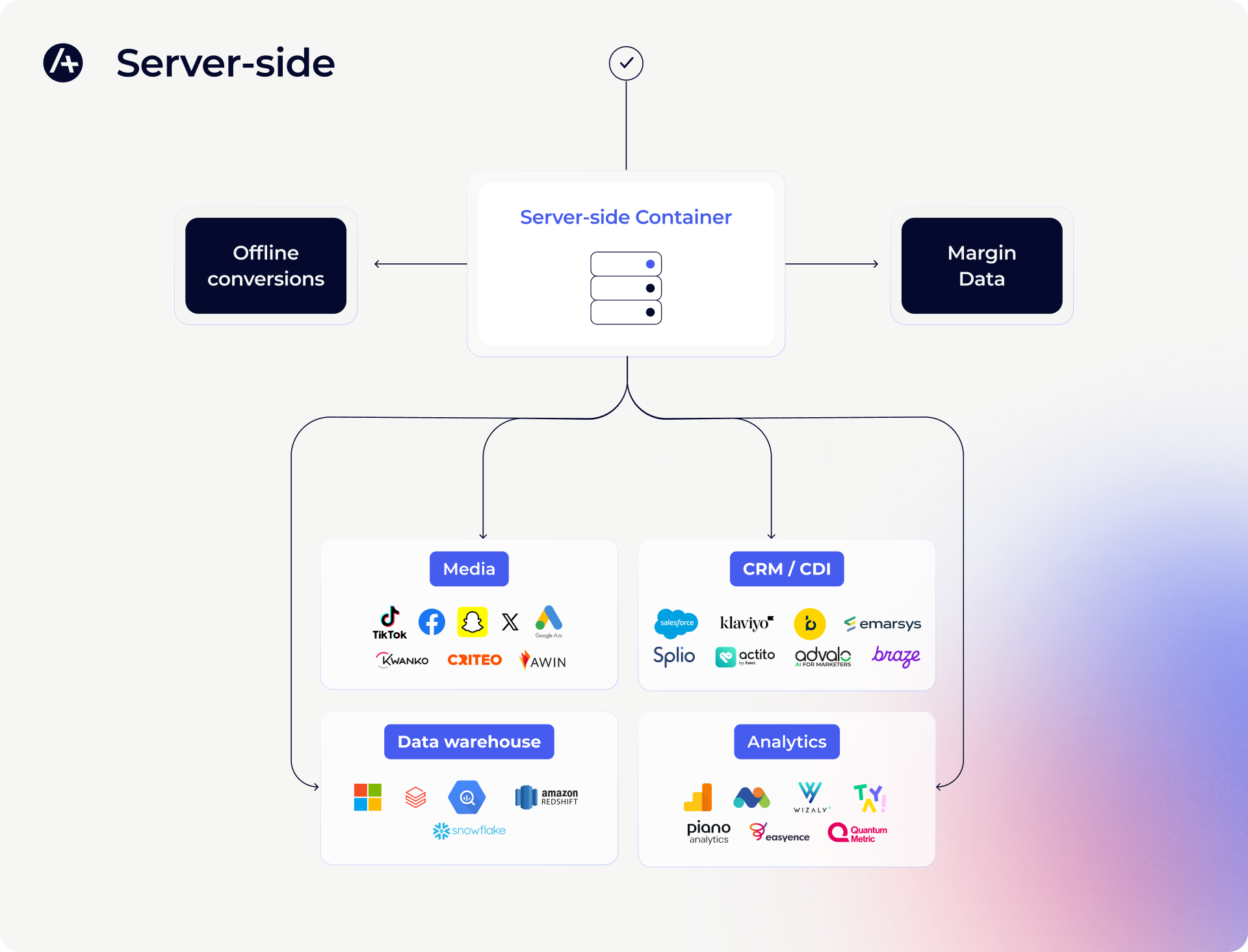
From that point on, your visitors' browsers no longer communicate directly with third parties. Your server takes over, letting you regain control of your data flows and lay solid foundations for what comes next.
Step 2: Optimize to stop losing data
Once the migration is done, two major issues still undermine the quality of your tracking. Addressing them means recovering a significant share of the data that was slipping away until now:
1) Adblockers
These extensions (uBlock Origin, AdBlock Plus, Brave Shield) do not just block ads; they also neutralize every tracking script whose URL is recognized as belonging to an advertising tool. For the 30 to 40% of users running a blocker, your events are simply not collected.
The solution is to load these scripts from your own subdomain with a random file name. Adblockers no longer recognize the URL and let the content through.
An important point: this technique only recovers signals from visitors who have given their consent. Your Consent Management Platform remains the entry point, and server-side never bypasses a refusal.
2) Safari
Apple limits the lifespan of cookies to 7 days. In practice, a user who clicks on your ad on a Monday and comes back to buy ten days later will be treated as a total stranger. The cookie has expired, and the sale is not attributed to your campaign.
On mobile, where Safari often accounts for more than 50% of traffic, the impact on your attribution is huge. Mechanisms such as Cookie Restore or Reverse Proxy keep these first-party cookies alive well beyond that limit.
Both optimizations are available directly through Addingwell, with no complex development work. They meaningfully improve the accuracy of your attribution and the completeness of the data sent to your platforms.
Step 3: Unify data
This third step is the mark of maturity, one that most companies have not yet reached. Yet it is by far the most impactful.
A well-tuned server-side setup collects and transmits your data reliably, but it will not automatically deliver a great improvement in your advertising performance. The real transformation happens when you move from transmission to enrichment.
Google, Meta, and the other platforms are not short of data. What they are looking for is signal quality. Their algorithms can now find your best customers, but only if you give them the right elements to recognize them. And most of your competitors are not yet sending those elements.
In practice, enriching your signals means feeding your platforms with real business data that is not found in your site's native data:
- Product margins, so the algorithm optimizes for profitability rather than for cart value alone
- CRM data, to tell a new customer apart from a loyal one and tailor the signals accordingly
- Offline conversions, to tie in-store or phone sales back to your digital campaigns
- Mobile data, to get a unified view of the customer journey, including across your apps
This information lives in your internal tools, from your CRM to your ERP. With a server-side setup properly configured through Addingwell, it can be centralized on the GTM Server side and sent automatically to your partner platforms, with no friction.
Are you making the most of your server-side setup?
Most companies have completed step 1, and many stop there, convinced that the server-side migration was the goal. In reality, it is the starting point.
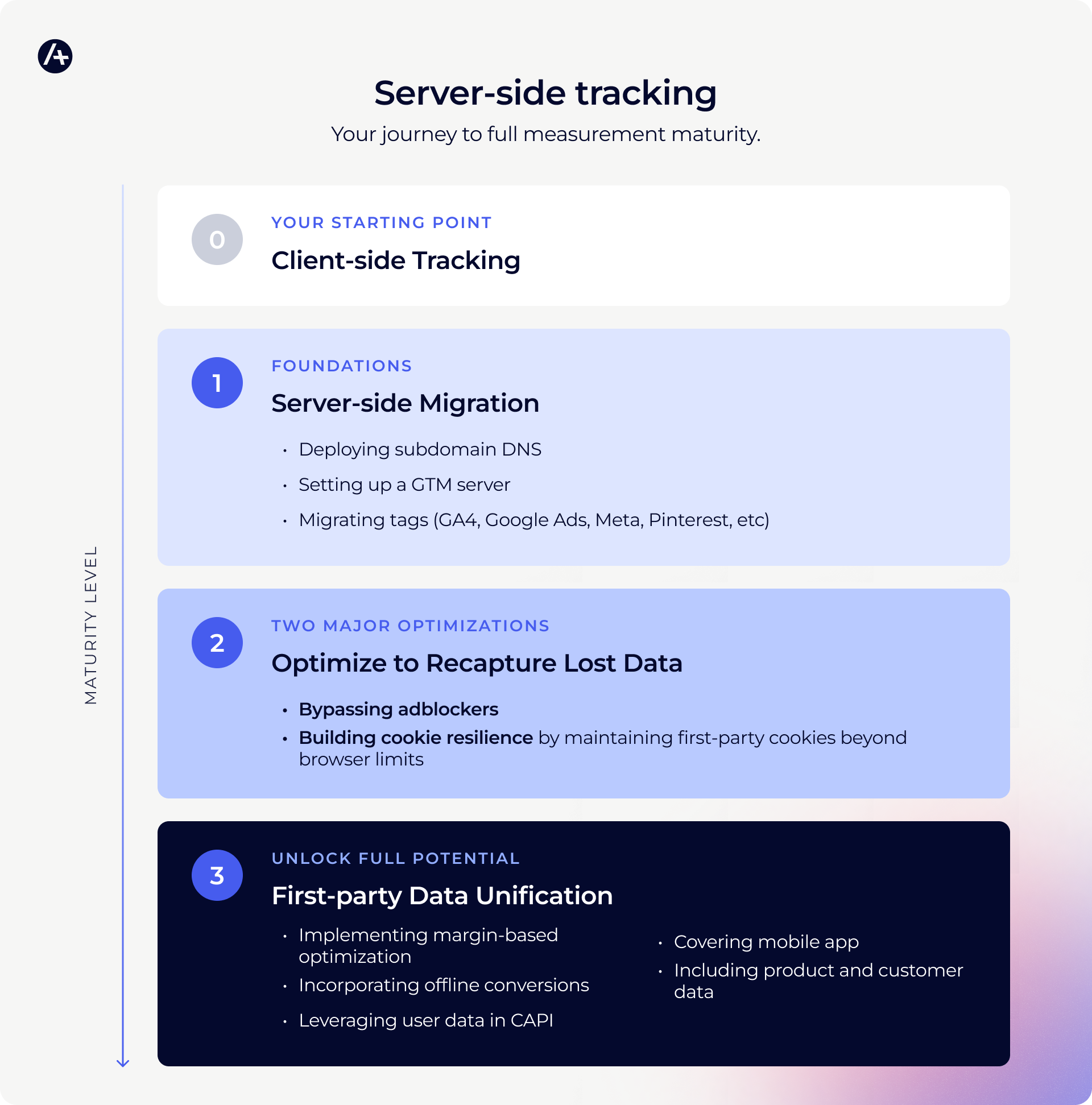
Every level translates into measurable gains. At level 2, you recover the data that adblockers and Safari were making you lose, and at level 3, you send your platforms signals that your competitors do not have.
Our customers tell the story: Damart recovered 16% more data by optimizing the group’s data collection practices, Sandaya gained 33% in ROAS by improving advertising signal reliability, and Maisons du Monde increased its campaign revenue by 12% by moving to enrichment thanks to the integration of margin data.
The quality of the data sent to platforms is not the only factor; creative strategy and campaign management matter just as much. But in an environment where everyone uses the same tools and targets the same audiences, the richness of your signals becomes a competitive advantage that is hard to catch up with.
To learn how our solutions and our network of technical and technology partners can help you maximize your data architecture, book a meeting with our teams.
The author